Audit ready AI model risk management in 90 days for compliance teams
AI model risk management is the discipline of identifying, testing, monitoring, and documenting the risks an AI system creates across its lifecycle, scaled to how much harm that model could cause. The NIST AI Risk Management Framework structures this into four functions, GOVERN, MAP, MEASURE, and MANAGE, while the EU AI Act sets the legal floor for high-risk systems. The immediate step for any compliance officer: classify every model by materiality and produce a model card for anything above low tier, a task platforms are built to automate.
TL;DR:
- Most AI models require higher levels of oversight than traditional models due to their probabilistic outputs, potential bias, hallucinations, and data poisoning risks.
- Implementing a lifecycle approach with governance, mapping, measuring, and managing is crucial for effective AI risk management, focusing on documentation like model cards and validation packs.
- Risk tiering based on impact, scale, reliance, and data sensitivity helps prioritize which models need board approval, validation, and ongoing monitoring.
- Validation and red-teaming must be independent, iterative, and well-documented with clear acceptance criteria, ensuring ongoing model safety and fairness.
- Building a comprehensive model inventory and documentation first significantly streamlines audits, especially when using automated platforms that align with multiple compliance standards.
Table of Contents
- What makes AI model risk management different from traditional model risk?
- How do GOVERN, MAP, MEASURE and MANAGE work in practice?
- How do you decide which models need the most oversight?
- What does rigorous validation and red-teaming actually look like?
- How should you monitor models once they're in production?
- What documentation does a compliance audit actually expect?
- Who owns what: roles, decision rights and approval gates
- What should compliance teams do in the next 90 days?
- Operationalising the framework without a dedicated AI risk team
- The gap between AI governance frameworks and what actually happens in practice
- Get audit-ready for AI model risk management faster
- Sources
What makes AI model risk management different from traditional model risk?
Traditional model risk management grew up around credit scoring and actuarial models: static formulas, fixed inputs, predictable outputs. AI systems behave differently, and that difference is the whole reason this discipline needs its own playbook.
A large language model or a machine learning classifier produces probabilistic outputs, not deterministic ones. Running the same prompt twice might yield different answers. Feeding it data that drifts from what it was trained on can degrade performance in ways not always flagged during validation. Add a third-party foundation model into the mix, licensed rather than built in-house, and you inherit a system whose training data, tuning decisions, and failure modes you may never fully see.
These aren't edge cases. They're structural features of how AI systems work, and they create risk categories that classic model risk frameworks never had to name:
- Bias baked into historical training data that resurfaces in lending, hiring, or insurance decisions.
- Hallucination, where generative models state incorrect information with total confidence.
- Data poisoning, where adversaries corrupt training or fine-tuning data to manipulate outputs.
- Misuse, where a model built for one purpose gets repurposed for something its validation never covered.
- Privacy leakage, where models trained on personal data inadvertently reproduce it.
The MindForge handbook, developed for financial institutions under Singapore's MAS, names biased data, hallucination, and inadequate human oversight among the top operational risks firms report, and recommends proportionate review at both pre-deployment and post-deployment stages rather than a single approval gate. This design choice, treating deployment as an ongoing checkpoint rather than a one-off sign-off, is what separates AI model risk management from the audit-once-a-year approach many compliance teams inherited from traditional model governance. NIST's framework and the Cloud Security Alliance's model risk framework both converge on the same conclusion: a lifecycle approach, tiered by risk, beats a static checklist every time.
How do GOVERN, MAP, MEASURE and MANAGE work in practice?
NIST's four-function structure gives compliance teams a shared vocabulary, but the real value comes from knowing what each function actually produces. Here's what each one looks like when you strip away the abstraction and ask "what document lands on my desk at the end of this?"
- GOVERN sets the rules before a single model gets built or bought. This means writing an AI risk appetite statement, defining who can approve which risk tier, and setting procurement rules that require supplier due diligence before any third-party model gets integrated. Governance also means deciding, in writing, what "acceptable risk" looks like for your organisation, not leaving it to whoever signs the vendor contract.
- MAP identifies what a specific model is for and where it could go wrong. This function documents intended use, maps the context the model operates in (who uses it, what decisions it feeds), and applies your materiality criteria to assign a risk tier. A fraud-detection model feeding automated account freezes maps very differently to an internal chatbot answering HR policy questions.
- MEASURE is where validation happens. This produces a validation plan, a set of performance, fairness, and security metrics, and evidence of testing, including red-team exercises that probe for adversarial failure. A retail bank testing a credit-decisioning model, for example, would validate not just accuracy but disparate impact across protected characteristics.
- MANAGE covers what happens once a model is live: mitigation plans for known weaknesses, an incident response path for when something breaks, and a reporting cadence that feeds continuous improvement back into GOVERN.
Every function should generate an artefact your auditors can actually hold: a model card, a validation pack, and a risk register entry. Skip the paperwork and you've done the thinking without leaving evidence you did it, which for a regulator amounts to the same as not having done it at all.
Pro Tip: Build your model card template before you build your first high-risk model. Retrofitting documentation onto a system that's already in production is far more painful than filling in a template as you go, and auditors can usually tell the difference between contemporaneous records and reconstructed ones.
Our internal AI governance framework playbook walks through how these four functions link to organisational accountability, useful if you're still deciding who owns GOVERN versus who owns MAP inside your structure.
How do you decide which models need the most oversight?
Not every model deserves a board-level review. Treat a spam filter with the same scrutiny as a credit-scoring engine and you'll burn your team's capacity on low-value checks while the genuinely risky models get the same rushed attention. Tiering exists to stop that from happening, and it's a principle regulators expect you to apply, not just a resourcing convenience.
Materiality should be scored against several concrete criteria:
- Impact: could a wrong output cause financial loss, physical harm, or a rights violation?
- Scale: how broadly the model is used or the volume of transactions affected
- Reliance: whether outputs have human oversight or are used autonomously
- Data sensitivity: whether it processes sensitive personal or financial information
- Rights and safety exposure: potential for discrimination, deception, or endangerment from failures
Once scored, models generally fall into several tiers, each with corresponding control baselines, ranging from low-impact internal tools like FAQ chatbots with basic documentation, to higher-impact systems requiring independent validation, red-teaming, and continuous monitoring for critical use cases such as fraud detection.
A useful way to stress-test tiering decisions: borrow probabilistic risk assessment techniques from aerospace and nuclear engineering, disciplines that have spent decades quantifying low-probability, high-consequence events. Applying that lens to a generative model deciding whether to autofill a legal clause forces you to ask what the worst plausible outcome looks like, not just the average one. Tiering isn't a bureaucratic exercise, either: treating every model identically wastes validation resources on low-risk systems and starves the genuinely material ones of the scrutiny they need.
What does rigorous validation and red-teaming actually look like?
Validation only counts as independent if the people testing the model didn't build it and don't report to whoever did. That single structural separation is what auditors look for first, and it's the part most SMEs get wrong, often because the same two or three people wear every hat on a small AI project.
Independence doesn't require a separate department. It requires evidence: a named validator distinct from the development team, a documented scope of what was tested, and sign-off that's traceable to someone with the authority to reject the model. For higher-tier models, that validator's findings should go to a risk committee or equivalent, not straight back to the development team for a quiet fix.
Red-teaming, adversarial testing designed to find where a model breaks rather than confirm it works, should be iterative and built into your validation cadence rather than bolted on as a pre-launch formality. Useful test scenarios include:
- Feeding the model deliberately misleading or out-of-distribution inputs to see how it responds.
- Testing for prompt injection or jailbreak attempts on generative systems.
- Checking outputs across demographic subgroups for disparate error rates.
- Simulating the exact misuse case your MAP stage flagged as most likely.
Document acceptance criteria before testing starts, not after you've seen the results. A sensible baseline might specify a minimum accuracy threshold, a maximum false-positive rate for high-impact decisions, and zero tolerance for outputs that expose personal data. Every test run should produce a dated report: what was tested, against what criteria, who signed off, and what remediation followed if the model failed.
Pro Tip: Keep a running red-team log rather than a one-off report. Auditors increasingly want to see that adversarial testing happens on a schedule, not just before go-live, and a dated log is the easiest way to prove it.
Our guide to EU AI Act cybersecurity obligations covers how validation evidence overlaps with broader security testing requirements, worth a look if your model touches infrastructure that's already in scope for other frameworks.
How should you monitor models once they're in production?
Validation tells you a model was fit for purpose on the day it launched. Monitoring tells you whether it still is six months later, and this is the stage where most compliance programmes quietly fall apart, because monitoring gets treated as an afterthought rather than a lifecycle function with its own budget and owner.
- Track four core signals continuously: performance metrics against the baseline set at validation, input data distribution to catch drift before it degrades outputs, safety flags such as blocked or escalated responses, and direct user feedback where it's available.
- Set alerting thresholds tied to your risk tier, not a one-size-fits-all rule. A critical-tier fraud model might need real-time alerting on any performance dip beyond a few percentage points; a low-tier internal tool can tolerate a monthly review instead.
- Define escalation paths in advance: who gets notified when a threshold breaches, how quickly they must respond, and what remediation options are pre-approved versus requiring fresh sign-off.
- Govern every production change through staged rollout: release to a small user segment first, compare outputs against the baseline (canarying), and hold an approval gate before full deployment.
- Keep a rollback plan ready for every high or critical-tier model, tested in advance rather than improvised during an incident.
The MAS MindForge handbook frames post-deployment review as an ongoing obligation, not a lapsed checkbox, and NIST's guidance similarly recommends scheduled evaluation of safety, fairness, and security metrics rather than a single point-in-time check. Change management discipline is what turns "we monitor our models" from a claim into something you can actually demonstrate.
What documentation does a compliance audit actually expect?
Auditors don't want a narrative about your AI programme. They want a document trail that lets them reconstruct, model by model, what it does, what it might get wrong, and who's accountable when it does. That's what a model card is for.
A usable model card should cover the intended use case, known limitations, the performance and fairness metrics recorded at validation, the risk tier assigned, and the named owner responsible for it. Treat it as a "nutrition label" for the model: factsheets serve exactly this centralising role, pulling metadata and evaluation results into one place instead of scattering them across emails and slide decks.
Beyond individual model cards, every audit will expect a working inventory. At minimum, that inventory should record:
- Model name, version, and deployment stage (development, staging, production, retired).
- Risk tier and the date it was last reassessed.
- Data provenance, including whether training data included personal or special-category information.
- Validation and red-team dates, with links to the underlying test reports.
- The named model owner and validator.
A centralised registry with these fields enforced, rather than optional, closes the visibility gap that turns audits and incident investigations into weeks-long archaeology projects. When something goes wrong with a model six months after launch, the registry should tell you within minutes what it does, who owns it, and when it was last validated, not send someone digging through old email threads.
Who owns what: roles, decision rights and approval gates
Governance fails in one of two directions: either nobody clearly owns a decision, so it gets made by default, or everyone has to sign off on everything, so nothing moves. The fix is a role structure that matches authority to risk tier.
A workable structure typically includes five roles. The model owner is accountable for the model's business purpose and day-to-day performance. The validator performs or commissions independent testing and must sit outside the development chain. The AI/MRM lead sets tiering criteria, maintains the registry, and coordinates escalations across models. The data steward answers for data provenance, quality, and lawful basis for processing. Legal and board oversight get engaged proportionately, reviewing high and critical-tier models rather than every deployment.
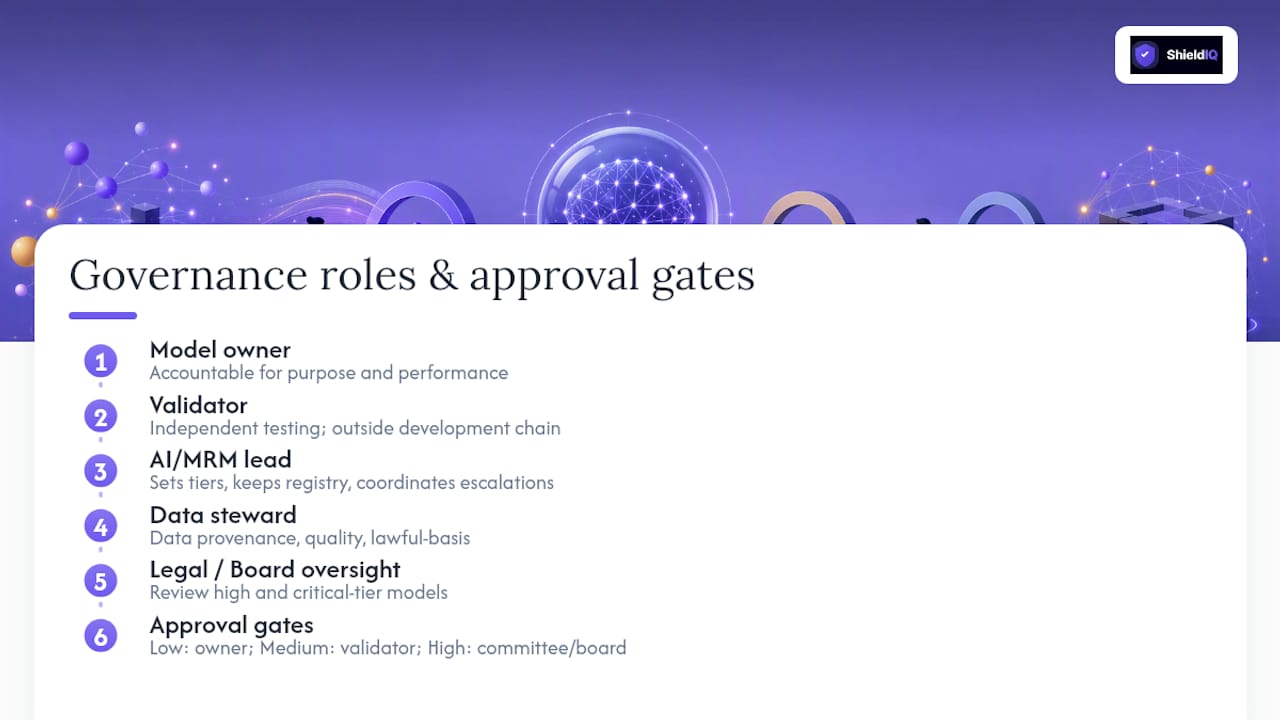
Approval thresholds should scale with tier: low-tier models might need only model-owner sign-off, medium-tier models a validator's confirmation, and high or critical-tier models a risk committee or board-level approval before go-live. Document every handover explicitly, particularly when a model owner leaves or a validator's scope changes, because an accountability gap discovered mid-audit is far worse than one flagged and closed in advance.
What should compliance teams do in the next 90 days?
Frameworks are only useful once they turn into a sequence of tasks someone actually does this quarter. Here's a starter checklist that moves a compliance programme from theoretical to demonstrable within 90 days.
- Build a complete model inventory covering every AI system in production or development, however small.
- Apply your tiering criteria to each entry and record the assigned risk tier with a rationale.
- Draft a model card for every medium-tier-and-above system, even if some fields say "not yet available".
- Write a validation plan for your highest-tier models first, specifying acceptance criteria before testing begins.
- Set a monitoring baseline, defining what "normal" performance looks like so drift is measurable rather than a gut feeling.
- Formalise your change-control process, including who approves production changes and what a rollback looks like.
Group your controls by category so nothing falls through the cracks: data controls (provenance checks, sensitivity classification), access controls (who can query or retrain a model), testing controls (validation and red-team cadence), logging controls (audit trails for inputs, outputs, and overrides), and supplier risk controls (due diligence on any third-party or foundation model you've licensed).
Pro Tip: Start with your highest-tier models, not your easiest ones. Compliance teams often tackle low-risk systems first because they're quick wins, but auditors and regulators care about coverage of the models that could actually cause harm.
Our ISO 42001 compliance guide for SMEs sets out how this 90-day sequence aligns with a recognised AI management standard, useful if you're aiming for external certification rather than internal assurance alone.
Operationalising the framework without a dedicated AI risk team
Most SMEs don't have a dedicated AI risk function, and building the artefacts above by hand, model cards, registries, validation packs, across every framework a regulator might ask about, becomes a full-time job nobody was budgeted for. This is a gap some platforms aim to close.
Some platforms map directly onto the lifecycle functions covered here:
- Automated assessments can score models against compliance criteria, generating gap analysis efficiently.
- Centralised inventories track models, their risk tiers, owners, and validation statuses in dashboards.
- Audit-ready exports turn model cards and risk register entries into documentation formats auditors expect.
- Cross-framework coverage allows a single model record to satisfy evidence requirements for multiple regulations.
This section is written by Matthew Lemon, who covers AI governance and regulatory compliance for ShieldIQ.
The gap between AI governance frameworks and what actually happens in practice
The biggest failure mode I've seen in AI model risk management isn't under-governance. It's over-governance applied unevenly: a rigorous sign-off process for a low-risk chatbot, and almost nothing for a decisioning model quietly influencing customer outcomes because nobody flagged it as "AI" in the first place. Frameworks like NIST's don't fail organisations; inconsistent application of them does.
The pragmatic fix isn't more paperwork. It's closing visibility gaps first, knowing what models exist before deciding how hard to govern each one, and then applying proportionate controls rather than a uniform standard. Auditors respond far better to evidence of judgement, a documented reason a model sits in the medium tier, than to a thick binder of generic policy that was never tailored to what the model actually does.
If there's one action worth prioritising above all others, it's building the inventory before anything else. Everything downstream, tiering, validation, monitoring, depends on knowing what you're managing.
— Matthew Lemon
Get audit-ready for AI model risk management faster
Building model cards, risk registers, and validation packs by hand across NIS2, GDPR, ISO 27001, and the EU AI Act at once is exactly the overhead that stalls most SME compliance programmes, and it's the specific problem ShieldIQ was built to remove.
The platform gives you a centralised inventory for every AI model in use, automated assessments that score maturity against EU AI Act and ISO 42001 criteria, and audit-ready exports that turn scattered documentation into a single evidence pack. Because it works across 17 industry standards from one dashboard, the same model record that satisfies your AI governance obligations can double up as evidence for ISO 27001 or GDPR audits, without duplicating the work. If your team is trying to operationalise the lifecycle approach covered here without hiring a dedicated AI risk function, explore ShieldIQ's EU AI Act compliance platform and start a free assessment to see where your current model inventory stands against the risk tiers that matter most.
Sources
- Artificial Intelligence Risk Management Framework (AI RMF 1.0)
- AI Risk Management: Executive Handbook (MindForge / MAS)
- Model governance - IBM watsonx.governance
- AI Model Risk Management Framework — Cloud Security Alliance