KnowBe4 alternatives for SMEs: 2026 shortlist
For most SMEs, the best alternative to KnowBe4 is an integrated platform that combines behaviour-led security awareness with audit-ready GRC evidence — not a standalone training library. The shortlist below reflects that priority, with each category mapped to the constraint most likely driving your switch.
Recommended shortlist for SMEs:
-
Integrated GRC (e.g. Shieldiqcyber’s ShieldIQ): best when audit evidence for NIS2, GDPR, or ISO 27001 is the primary driver
-
Adaptive behaviour platforms: best when phishing click rates have plateaued and engagement is the blocker
-
Email-security-tied awareness tools: best when your organisation already runs a specific email security stack
-
Compliance-first awareness platforms: best when policy workflows and audit trails are the core requirement
-
Open-source or low-cost monitoring tools: viable for very tight budgets, though they typically lack built-in audit-ready evidence exports
Start with a ShieldIQ trial if you need automated compliance evidence for Cyber Essentials, NIS2, or ISO 27001 alongside an awareness programme. The NCSC’s guidance on security culture and the Cyber Essentials scheme both reinforce that awareness training must be evidenced — not just delivered.
Table of Contents
-
Which KnowBe4 alternatives give SMEs what they actually need?
-
How to choose the right security awareness platform for your SME
-
What does switching actually cost, and how long does it take?
Which KnowBe4 alternatives give SMEs what they actually need?
Integrated platforms that combine awareness training with risk and compliance workflows reduce the need for separate GRC tooling and simplify audit evidence collection. That single point separates the categories below more than any feature list.
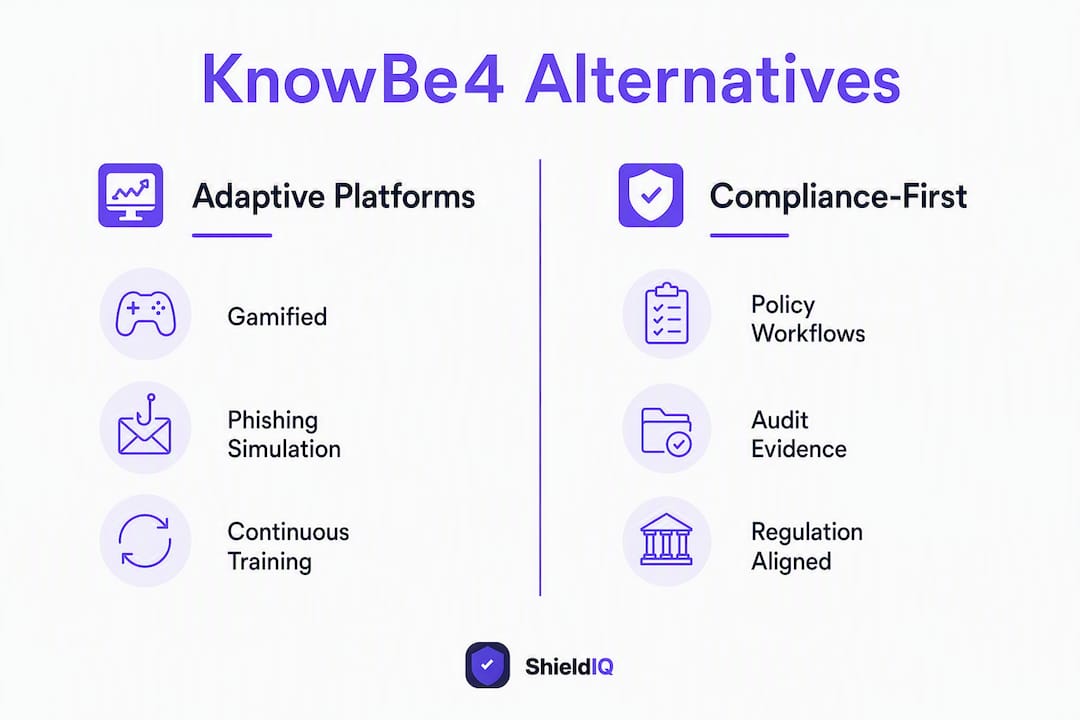
| Category | Best SME use-case | Phishing simulation | Adaptive/gamified learning | GRC / audit evidence | mpliance (NIS2, GDPR, CE, ISO 27001) | Admin effort | Pricing shape |
|---|---|---|---|---|---|---|---|
| Integrated GRC + awareness | Audit-ready compliance + awareness in one platform | Included or via integration | Moderate | Strong: automated exports, control mapping | Full cross-framework | Low | Subscription tiers |
| Adaptive behaviour platforms | Engagement plateau, measurable behaviour change | Core feature, per-user difficulty | High: gamified, continuous | Limited without add-ons | Partial | Medium | Per-user or quote |
| Email-security-tied awareness | Existing email security stack | Tied to live threat data | Moderate | Moderate, stack-dependent | Stack-dependent | Low if stack matches | Bundle or quote |
| Compliance-first awareness | Policy workflows, audit trails, training alignment | Included | Low to moderate | Strong: policy + training workflows | Strong | Medium | Per-user or quote |
| Open-source / low-cost tools | Minimal budget, basic monitoring | Limited | Minimal | Weak: lacks audit-ready policy workflows | Minimal | High (manual) | Free or low licence |
Pro Tip: When a vendor claims “behaviour change,” ask for independent phishing test metrics from a pilot — specifically the click-rate reduction over 90 days and the format of their evidence export. If they cannot produce both, treat the claim as unverified.
How to choose the right security awareness platform for your SME
Decide by the single constraint driving the switch: if the issue is engagement, pilot an adaptive platform; if it is audit evidence, prioritise a GRC-integrated solution. That rule alone eliminates most of the noise.
Selection checklist (ordered by SME priority):
-
Audit evidence first. Can the platform export evidence in a format your auditor accepts for ISO 27001, NIS2, or Cyber Essentials? Request a sample export before signing.
-
Admin overhead. How much manual configuration does the platform require per campaign? SSO/SCIM and SIEM connections are common deal-breakers during pilots — confirm these before you commit.
-
Measurable outcomes. Define your pilot success criteria upfront: target phishing click-rate reduction, reporting export format, and required integrations. Vendors who resist this are worth questioning.
-
Cost predictability. Many vendors use quote-based pricing for advanced modules, so direct cost comparison requires a defined module list and headcount. Per-user models can look cheaper at 50 seats and become expensive at 150.
-
UK data residency. Confirm where training data and evidence are stored. For GDPR compliance, UK or EEA data residency matters.
Questions to ask vendors during a trial:
-
What is the pilot length, and what metrics do you report at the end?
-
Can I export audit evidence in PDF and CSV for an ISO 27001 or NIS2 audit?
-
Do you support SSO (SAML 2.0), SCIM provisioning, and HRIS integration?
-
Where is data stored, and do you hold UK or EEA data residency?
-
Is pricing per user, per module, or quote-based — and what triggers a price increase?
Red flags: opaque pricing with no published tiers, no sample audit export available during trial, and no named UK data centre or residency commitment.
What each alternative category actually delivers for SMEs
Adaptive behaviour platforms
These platforms — including options like Hoxhunt — focus on continuous, gamified phishing simulations that adjust difficulty per user. If employee engagement is the primary blocker, gamified and adaptive platforms tend to show higher interaction and measurable behaviour change in pilots. The trade-off is that GRC evidence exports are often limited or require additional tooling, which adds admin burden for compliance-led SMEs. Deployment is typically SaaS with straightforward onboarding.
Compliance-first awareness platforms
Platforms such as MetaCompliance place policy workflows and training alignment at the centre. MetaCompliance is rated 4.6/5 on G2 and is built around compliance and policy management workflows. They support audit trail generation, though the depth of cross-framework control mapping varies. Data residency options are generally available; confirm during procurement.
Email-security-tied awareness
Mimecast Awareness Training and Proofpoint Security Awareness both tie phishing simulation to live threat data from their email security layers. For SMEs already running those stacks, the integration reduces admin effort. Outside those stacks, the value proposition weakens. Cofense similarly focuses on phishing simulation depth tied to detection and response workflows, making it a strong fit when triage processes are a priority.
Open-source and low-cost monitoring tools
These reduce licensing costs but lack built-in, audit-ready policy workflows and evidence exports needed for frameworks like NIS2 or ISO 27001. For a UK SME facing a Cyber Essentials assessment or an ICO audit, the manual effort required to produce compliant evidence typically outweighs the licence saving.
Shieldiqcyber’s ShieldIQ: the integrated GRC + awareness option
ShieldIQ is built for SMEs that need automated compliance evidence across multiple frameworks without a full-time security team. The platform covers NIS2, GDPR, ISO 27001, Cyber Essentials, and more, with automated assessments, cross-framework control mapping, gap analysis, and audit-ready evidence exports. Optional vCISO and consulting services are available for SMEs that need implementation support or audit preparation. For a UK SME that needs both a measurable awareness programme and audit-ready compliance evidence in one place, ShieldIQ removes the need to stitch together separate tools. You can explore Cyber Essentials coverage and ISO 27001 automation through the platform directly.
Pro Tip: Map your awareness outcomes to your risk register from day one. SME teams gain the most value when awareness training is directly linked to risk scoring and automated evidence exports for auditors, rather than run as a separate compliance checkbox.
Practical migration checklist if you switch platforms
-
Define pilot scope. Select one department (20–50 users), set a 60–90 day pilot window, and agree on success metrics before launch.
-
Audit your current evidence. Export all existing training records, phishing simulation results, and policy acknowledgements from your current platform before cancelling.
-
Map integrations. Confirm SSO, SCIM, HRIS, and SIEM connections with the new vendor. Integration gaps discovered mid-rollout are the most common cause of delays.
-
Configure user segmentation. Group users by role and risk profile before the pilot begins — this is what makes adaptive platforms work.
-
Run the pilot and measure. Track phishing click-rate change, training completion, and evidence export quality against your pre-agreed criteria.
-
Phase the rollout. Move from pilot group to full organisation in two phases, with a comms plan for each. Allow four weeks per phase for an SME of up to 200 users.
-
Preserve audit trails. Keep a copy of all evidence from the outgoing platform for at least 12 months to cover any retrospective audit requests under NIS2 or GDPR.
For SMEs without internal resource to manage the migration, vendor-run managed services or a vCISO engagement can compress the timeline significantly.
What does switching actually cost, and how long does it take?
A typical SME migration runs across three phases. The pilot phase (weeks 1–8) involves platform configuration, integration setup, and a controlled user group. The integration phase (weeks 6–10, overlapping) covers SSO, HRIS, and SIEM connections — this is where opaque pricing and high minimum seat counts tend to surface as surprises if not clarified upfront. The full rollout phase (weeks 10–20) covers all users, communications, and reporting sign-off.
Cost bands vary by platform type and SME size. Licensing for awareness-only platforms typically runs on a per-user basis; integrated GRC platforms use subscription tiers based on frameworks and modules. Professional services for implementation add cost but reduce internal labour. For most UK SMEs, the total cost of switching is lower than the cost of a compliance failure or a failed audit — particularly with NIS2 enforcement now active across the EU and UK regulators watching closely.
Key takeaways
The most effective approach for SMEs is an integrated GRC and behaviour-led awareness platform that produces audit-ready evidence for NIS2, GDPR, Cyber Essentials, and ISO 27001 — not a standalone training library.
| Point | Details |
|---|---|
| Choose by your constraint | If the issue is engagement, pilot an adaptive platform; if it is audit evidence, prioritise a GRC-integrated solution. |
| Audit evidence is non-negotiable | Request a sample evidence export before signing any contract — confirm it meets your auditor’s format requirements. |
| Watch the pricing trap | Quote-based pricing for advanced modules means you need a defined headcount and module list to compare costs accurately. |
| Integration gaps cause delays | Confirm SSO, SCIM, HRIS, and SIEM support before the pilot begins — these are the most common deal-breakers. |
| Shieldiqcyber’s ShieldIQ | ShieldIQ combines automated compliance evidence, cross-framework controls, and optional vCISO support for UK SMEs in one platform. |
The gap between training completion and real compliance
Most SME compliance leads I speak with are measuring the wrong thing. Training completion rates look good in a board report, but they tell you nothing about whether your organisation would actually resist a phishing attack or pass an ICO audit. The platforms worth piloting are the ones that produce two outputs simultaneously: a measurable reduction in risky behaviour (tracked through phishing simulation metrics) and exportable evidence that satisfies an auditor. Those two outputs rarely come from the same tool unless the platform was built with both in mind. The instinct to buy the biggest training library is understandable, but for a UK SME with limited internal resource, a smaller, integrated platform that automates evidence collection will almost always deliver more compliance value per pound spent.
Pro Tip: When reporting to leadership, present phishing click-rate trends alongside evidence export readiness — not just completion percentages. That combination is what moves a board from “we have training” to “we are audit-ready.”
ShieldIQ: audit-ready compliance forSMEs
Compliance without evidence is just paperwork. Shieldiqcyber’s ShieldIQ platform gives UK SMEs automated assessments, cross-framework control mapping, and audit-ready evidence exports for NIS2, GDPR, ISO 27001, and Cyber Essentials — without needing a full-time security team to run it. The AI-powered gap analysis identifies where your controls fall short and generates the policies and evidence your auditor needs.
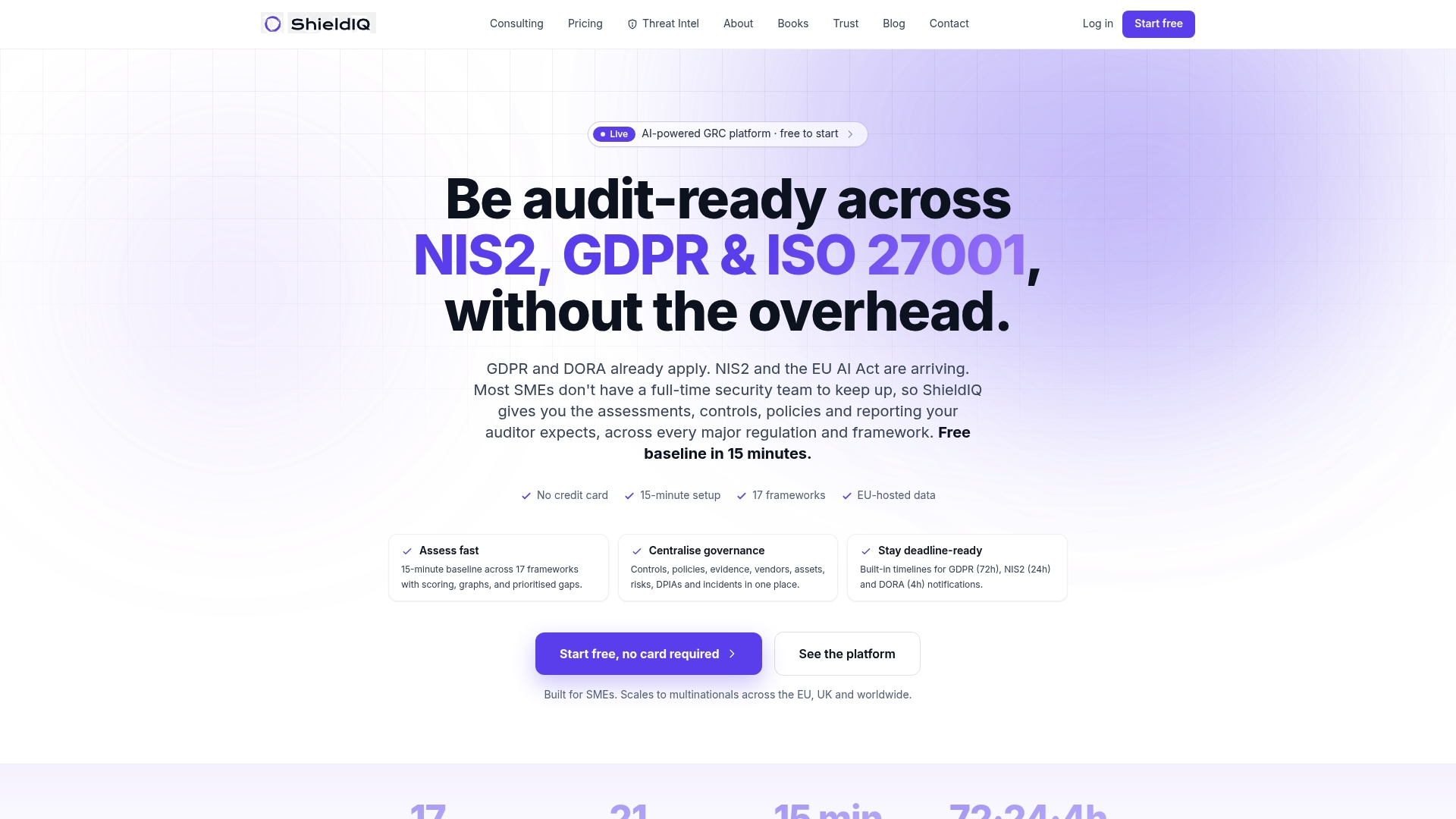
For SMEs that need implementation support, ShieldIQ’s consulting and vCISO services cover audit preparation, security awareness training design, and GRC strategy. You can start with a free assessment or book a demo to see the evidence exports and compliance dashboards in action. If you are evaluating security awareness platforms alongside broader compliance needs, proactive cybersecurity planning should inform your vendor selection from the outset.
Further reading and official resources for UK compliance
Use these sources to validate vendor claims and support your procurement conversations:
-
NCSC Security Culture Guidance — the authoritative UK reference for building measurable security culture
-
ICO Guidance on GDPR and Staff Training — confirms what evidence the ICO expects for staff awareness
-
Cyber Essentials Scheme (NCSC) — the UK government-backed certification relevant to most SMEs
-
Gartner Peer Insights: Security Awareness CBT — verified buyer reviews across the main platforms
-
ShieldIQ: NIS2 vs GDPR vs DORA comparison — practical framework comparison for UK and EU SMEs
During a vendor pilot, cross-reference the platform’s evidence export against the ICO’s accountability expectations and the NCSC’s Cyber Essentials technical requirements. If the export does not map to those standards, raise it with the vendor before you commit to a contract.