Regulatory change management: a practical guide for compliance teams
Regulatory change management is the process an organisation uses to detect, assess and embed new or amended regulatory obligations before they become compliance failures. Get this right and a new rule becomes a routine task. Get it wrong and it becomes a fire drill, or worse, a finding.
If a regulatory alert has just landed on your desk, here is what to do in the next 24 to 72 hours:
- Log the change in a central intake register, even if it is just a spreadsheet.
- Assign a single owner. No change should sit ownerless.
- Flag the jurisdiction and effective date immediately.
- Run a first-pass triage: does this actually change an obligation, or is it noise?
Then follow this rapid workflow:
- Confirm the source and scope of the change.
- Route it to the right subject matter expert for impact assessment.
- Decide: adopt, adapt, or monitor further.
- Assign implementation tasks with deadlines.
- Capture evidence as you go, not after the fact.
Key Takeaways
Regulatory change management succeeds when centralised intake, clear ownership, and automated evidence capture replace ad hoc tracking across scattered teams.
| Point | Details |
|---|---|
| Define ownership early | Assign a single owner per regulatory change before building any tooling around it. |
| Follow the seven pillars | Monitor, intake, assess, decide, implement, capture evidence, and sustain, in that order. |
| Sponsorship drives adoption | Prosci's research ties manager engagement directly to successful change outcomes, not just policy quality. |
| Tailor the approach to scale | BCG's findings show a small firm and a large multinational need different RCM designs, not one universal formula. |
| Automate evidence, not judgement | ShieldIQ automates mapping, evidence capture, and audit exports across EU frameworks, while final decisions still need human review. |
Table of Contents
- What does regulatory change management actually cover?
- Why does poor regulatory change management cost so much?
- What are the core pillars of an RCM programme?
- How does a regulatory change move from alert to closure?
- Who should own regulatory change management?
- Which parts of RCM should you automate?
- How should you sequence an RCM implementation?
- What should you measure to know RCM is working?
- What does an RCM rollout actually cost?
- Why do RCM programmes stall, and how do you fix it?
- How does ShieldIQ support a working RCM programme?
- What do practitioners see actually working?
- How ShieldIQ fits into your regulatory change management setup
- Where to read more on regulatory change management
- Frequently asked questions about regulatory change management
- Sources
What does regulatory change management actually cover?
Regulatory change management, often shortened to RCM, is not the same thing as regulatory compliance in general. RCM is the mechanism: the specific set of activities that catch a change, work out what it means for your organisation, and push it through to implementation with a paper trail behind it. Compliance is the outcome. RCM is how you get there repeatedly, without reinventing the process every time a regulator publishes something new.
Inside the boundary of RCM sit six activities: monitoring, intake, assessment, decisioning, implementation, and evidence management. Outside that boundary, but closely linked, sit regulatory relations (the relationship with the regulator itself), legal interpretation, and remediation when something has already gone wrong. A well-run RCM function feeds information to all three without trying to own them.
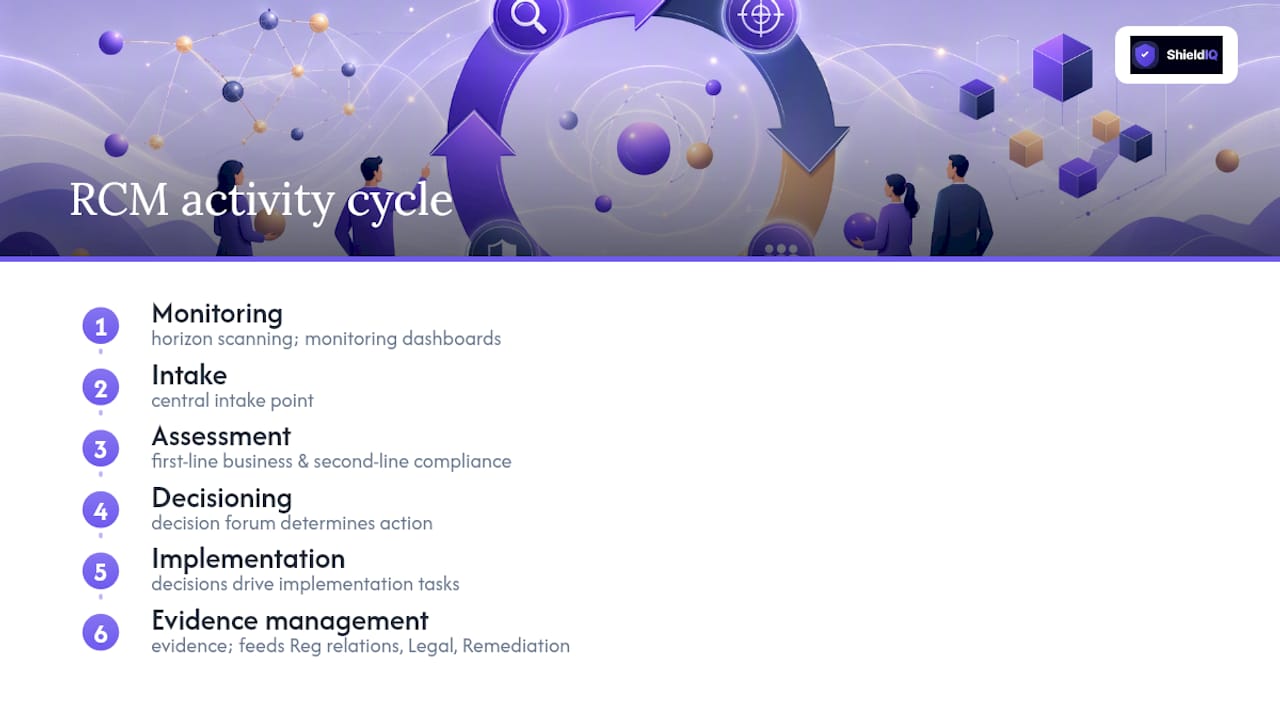
Picture this as a simple flow diagram: a horizon-scanning function feeds a central intake point; intake routes to first-line business owners and second-line compliance for assessment; assessment feeds a decision forum; decisions drive implementation tasks; implementation generates evidence; evidence feeds back into monitoring dashboards. Deloitte frames this as a strategic capability that needs centralised governance to demonstrate traceability, rather than a task list scattered across departments.

Why does poor regulatory change management cost so much?
Weak RCM shows up as fines, but the more common cost is the slower bleed of remediation projects, duplicated effort, and staff who no longer trust the compliance function to tell them what actually matters. A missed deadline on a single obligation can trigger a full audit finding, and audit findings tend to multiply once a regulator starts looking closely at how changes get tracked.
Proactive RCM flips that equation. Teams with structured intake and clear ownership respond to new obligations in days rather than weeks, because nobody is searching for who owns the problem. Audit readiness becomes a by-product of daily work rather than a scramble every 12 months.
- Fines and enforcement action follow gaps in tracking, not just gaps in policy.
- Remediation projects after a missed deadline usually cost more than the original implementation would have.
- Operational disruption often outweighs financial penalties, particularly when systems or contracts need urgent rework.
- Reputational harm compounds when regulators or clients notice repeat failures rather than isolated ones.
Prosci's research on regulatory change identifies sponsorship and manager engagement as the two strongest contributors to successful adoption, ahead of the technical quality of the policy itself.
Pro Tip: Don't measure success by how many policies you've updated. Measure it by how many people actually changed what they do day to day. A policy nobody follows is not a compliant policy.
What are the core pillars of an RCM programme?
A durable RCM programme rests on pillars rather than a single tool or checklist. Each pillar handles a distinct failure mode, and skipping one tends to create a blind spot that surfaces later, usually during an audit.
- Horizon scanning and monitoring. Continuous tracking of regulators, consultation papers, and guidance updates across every jurisdiction you operate in.
- Central intake and triage. One place where every alert lands, gets logged, and gets a first substantive-change filter applied.
- Impact assessment and mapping. Linking the regulatory text to the specific policies, controls, and processes it actually touches.
- Decisioning and prioritisation. A forum or owner who decides what happens next and by when.
- Implementation and control changes. The actual work: updating policies, retraining staff, adjusting system configurations.
- Evidence and audit trail. Recording what changed, who approved it, and when it was tested.
- Sustain and review. Periodic checks that the change stuck, rather than assuming it did.
Deloitte's model for strategic regulatory management treats monitoring, intake, tracking, and KRIs as the four foundational elements, with a centralised team, sometimes called an RCM Central Team or Regulatory Programme Office, coordinating across them.
Take a single example: a data protection regulator issues new guidance on breach notification timelines. Mapped correctly, that one update touches your incident response policy, your staff training deck, and the specific control test that checks whether your breach notification workflow actually meets the new deadline. Miss the mapping step and you might update the policy while leaving the training and the control test untouched, which is exactly the gap auditors find first.
Pro Tip: Build your pillar checklist before you buy any tool. A platform that automates a broken process just automates the mistakes faster.
How does a regulatory change move from alert to closure?
Every regulatory change should travel a defined path, whether it is handled by two people in a small compliance team or a dedicated function of twenty. The steps stay the same; only the resourcing changes.
- Awareness. The change is detected through horizon scanning, a regulator bulletin, a legal update, or an internal flag.
- Triage. The central intake team applies a substantive-change filter: does this alter an existing obligation, or is it a minor clarification?
- SME assessment. A subject matter expert, in compliance, legal, or the affected business unit, works out the practical impact.
- Action plan. The team documents what needs to change: policy, training, system configuration, contracts, or all four.
- Implementation. Owners execute the plan against a deadline tied to the regulation's effective date.
- Testing. Someone independent checks that the change actually works as intended, not just that it was documented.
- Closure. Evidence is filed, and the change is marked complete with a clear audit trail.
An intake template makes this repeatable. At minimum, capture:
- Source of the alert (regulator, jurisdiction, or internal legal team)
- Effective date and any transition period
- Affected obligations, policies, and systems
- Assigned owner and reviewing SME
- Severity or risk rating
- Key milestone dates: assessment due, implementation due, evidence due
Timelines matter more than most teams admit. A workable set of service levels looks like this: triage within 48 hours of an alert landing, initial SME assessment within five working days, and a documented action plan within two weeks for anything rated medium risk or above. High-risk changes, particularly those with a regulator-set deadline under three months, need an accelerated path that bypasses the standard queue.
Evidence capture deserves its own discipline here. Compliance leads consistently flag that the biggest audit risk isn't missing the deadline, it's failing to record the link between the regulation, the policy edit, the training completion, and the control test. Build that trail as you go, not retrospectively when an auditor asks for it. Formable's guide to contract workflow management covers a similar discipline for versioning and approval trails on the legal side, worth reviewing if your changes touch contractual terms.

Communication runs alongside every step. A literature synthesis of change management strategies across 16 models found that communication and stakeholder involvement appear more consistently than almost any other tactic, more so than training alone.
Who should own regulatory change management?
RCM fails when ownership is ambiguous, and it fails just as often when ownership sits with one overworked compliance officer trying to track everything alone. The fix is a defined governance model with named roles, not a bigger to-do list.
- Executive sponsor. Someone senior enough to unblock resourcing and prioritisation disputes.
- Central RCM team or Regulatory Programme Office. Owns intake, triage, and the tracking system.
- Compliance SME. Assesses substantive impact and advises on interpretation.
- Legal. Confirms the regulatory reading, particularly where ambiguity exists.
- First-line owners. The business units that actually implement the control or process change.
- Change champions and people managers. Reinforce adoption day to day, catching the gap between "policy updated" and "behaviour changed".
A simple RACI table works well here: for each pillar (monitoring, intake, assessment, decisioning, implementation, evidence), mark who is Responsible, Accountable, Consulted, and Informed. Most disputes in RCM programmes trace back to two roles both thinking they were Accountable, or neither thinking they were.
Governance patterns vary by size. Larger organisations run a centralised RCM team with a cross-functional forum, often monthly, to prioritise competing changes. Smaller teams often combine the RCM function with existing compliance headcount, but the forum still needs to exist, even if it is a 30 minute call.
Pro Tip: Sponsorship isn't a signature on a charter. Prosci's research on regulatory change ties sponsorship and manager engagement directly to adoption outcomes, meaning your sponsor needs to actually show up when priorities get contested, not just at kickoff.
Which parts of RCM should you automate?
Not every step in the RCM workflow benefits equally from automation. Some tasks are genuinely suited to it; others still need a human with judgement.
Automation earns its place in:
- Monitoring and filtering. Scanning regulator publications and filtering out non-substantive updates before they reach an SME's inbox.
- Obligation mapping. Suggesting which internal policies or controls a new rule likely touches, as a starting draft.
- Workflow routing. Automatically assigning tasks to owners based on jurisdiction, framework, or business unit.
- Evidence capture and audit trails. Logging timestamps, approvals, and version history without manual re-entry.
- Reporting and dashboards. Pulling status data into a single view rather than chasing spreadsheets.
When evaluating a platform, run through this checklist:
- Does it cover the regulators and jurisdictions you actually operate in?
- Does it filter substantive changes from routine noise, or dump everything into one feed?
- Does it map changes to specific obligations, or just list them?
- Does it generate audit-ready exports, or just internal reports?
- Does it automate SLA tracking for triage and assessment deadlines?
KPMG's guidance on regulatory change management argues that combining technology with governance is what makes RCM proactive rather than reactive, and cost-efficient at scale rather than a growing headcount problem.
Pro Tip: AI accelerates the drafting and first-pass mapping of a regulation to your internal processes, but the final call on whether that mapping is correct still needs a human who understands your business. Treat AI output as a strong first draft, never as the final answer.
How should you sequence an RCM implementation?
Building RCM capability from scratch takes most organisations six to nine months to reach a workable baseline. Trying to do everything at once is the single most common reason these projects stall.
- Months 0 to 3: Inventory every regulation and framework that applies to you, and stand up basic horizon scanning. Even a shared spreadsheet with assigned owners beats no system at all.
- Months 3 to 6: Build the intake and assessment workflow. Define your triage SLA and get the RACI agreed before you touch tooling.
- Months 6 to 9: Layer in automation for evidence capture, reporting dashboards, and audit exports.
Prioritise early work using an impact versus effort view: tackle high-impact, low-effort fixes first (a shared intake register, a named owner for each regulation), and defer high-effort, low-impact projects (a bespoke reporting dashboard) until the basics are solid.
- Start with the regulations that carry the shortest compliance deadlines, not the ones that feel most urgent politically.
- Avoid buying automation before your manual process is defined; automating chaos just produces faster chaos.
- Don't skip the RACI exercise, however tempting it is to "just get started".
- Watch for scope creep: RCM tracks change, it does not need to become a general compliance management system on day one.
What should you measure to know RCM is working?
A handful of metrics tell you more about RCM health than a long compliance report ever will. Track detection lag (time between a regulation being published and it entering your intake system), assessment SLA adherence, time to remediation, and the percentage of changes with a fully mapped evidence trail.
- Detection lag: how long between publication and internal logging.
- Assessment SLA adherence: percentage of changes assessed within the agreed window.
- Time to remediation: average days from decision to completed implementation.
- Evidence completeness: percentage of closed changes with a full audit trail attached.
- Audit findings tied to regulatory change: a leading indicator of process gaps, not just outcomes.
A workable reporting rhythm runs on three cadences: daily or weekly operational triage within the team, monthly summaries to management, and quarterly reporting to the board. Deloitte's framework treats KRIs as a foundational element of a strategic RCM programme, not an afterthought bolted on for audit season.
For non-technical executives, present trend lines rather than raw counts. A board member does not need to know how many alerts came in this quarter; they need to know whether detection lag is improving or getting worse.
What does an RCM rollout actually cost?
Timelines vary sharply by ambition. A light implementation, covering one or two frameworks with mostly manual processes, can reach basic operational maturity in three to four months. A medium rollout across several frameworks with partial automation typically takes six to nine months. A heavy, multi-jurisdiction programme with full automation and integration into existing GRC systems can run twelve months or more.
- Scope of regulations covered is the single biggest cost driver; each additional framework adds mapping and monitoring overhead.
- Degree of automation shifts cost from ongoing headcount to upfront platform investment.
- Integration complexity with existing systems (HR, contract management, ticketing) adds time and consultancy fees.
- People hours for assessment and implementation remain the largest recurring cost even after automation.
SMEs with limited budget should stage investment: start with intake and triage manually, then automate evidence capture once the process is proven, rather than buying a full platform before the workflow is defined.
Why do RCM programmes stall, and how do you fix it?
Most RCM programmes hit the same handful of walls. Monitoring generates too much noise, ownership stays unclear past the pilot phase, evidence gets captured retrospectively (badly), SMEs run out of capacity, and decisions sit unmade for weeks.
- Monitoring noise: apply substantive-change filters so SMEs only see alerts likely to affect an actual obligation, rather than every regulator press release.
- Unclear ownership: fix this at the RACI stage, before the first real change arrives, not after the second missed deadline.
- Weak evidence capture: automate the audit trail at the point of implementation, linking regulation to policy edit to training record to control test.
- SME capacity gaps: rotate assessment duties or build a lighter-weight triage tier so not every change needs a full legal review.
- Slow decisioning: set a hard SLA for the decision forum, and escalate anything unresolved after two cycles.
Pro Tip: There is no universal best practice here. BCG's research on change strategy found that the right approach depends on your organisation's structure, social networks, scale of change, and staff sentiment. A 40-person firm and a 4,000-person multinational need genuinely different RCM designs, not the same playbook at different sizes.
How does ShieldIQ support a working RCM programme?
An AI-enabled GRC platform earns its place in an RCM programme by handling the pillars that create the most drag: mapping, workflow routing, and evidence capture. ShieldIQ applies this directly across EU frameworks including NIS2, GDPR, ISO 27001, and DORA, running automated assessments with scoring and gap analysis so a new obligation gets mapped to existing controls rather than sitting in a spreadsheet awaiting manual review.
- Automated assessments flag which controls a regulatory change likely touches, giving SMEs a starting point rather than a blank page.
- Audit-ready exports generate the evidence trail auditors ask for, without manual reconstruction after the fact.
- Deadline tracking and prioritisation tools surface what needs action first across every framework you're managing at once.
A typical adoption path: month one, map existing frameworks and import current controls; month two, configure automated monitoring and assign owners; month three onward, run live assessments and build the evidence library as changes land.
Pro Tip: Don't try to onboard every framework on day one. Start with the regulation carrying your nearest deadline, prove the workflow, then expand coverage.
What do practitioners see actually working?
Across RCM programmes that hold up under audit scrutiny, one pattern repeats: evidence management gets treated as a first-class discipline, not an afterthought. Teams that link the original regulatory text to the policy edit, the training record, and the control test at the moment of implementation rarely scramble when an auditor asks for proof. Teams that try to reconstruct that trail six months later almost always find gaps.
The trade-offs are real and worth naming honestly. Speed versus completeness is the constant tension: triaging every alert with full rigour is thorough but slow, while a lighter substantive-change filter is faster but risks missing something subtle. Automation versus human review carries a similar tension. AI accelerates the first-pass mapping of a regulation to internal processes, but the final judgement call still needs someone who understands how the business actually operates, not just what the regulation says on paper.
What sustains change long after the initial rollout is reinforcement, not documentation. A policy updated once and never revisited drifts. Governance forums that check adoption quarterly, not just at go-live, are what separate programmes that hold from programmes that quietly decay.
Pro Tip: If your RCM programme only ever produces documents, it isn't working yet. Sustained compliance shows up in behaviour, and behaviour only sticks with ongoing reinforcement.
How ShieldIQ fits into your regulatory change management setup
If you've been piecing together RCM through spreadsheets, shared drives, and someone's personal tracking system, ShieldIQ replaces that patchwork with one dashboard covering monitoring, mapping, evidence, and reporting across the frameworks that actually apply to your organisation.
ShieldIQ is built specifically for SMEs that need audit-ready compliance without hiring a dedicated security team or bringing in external consultants for every framework change. The platform runs automated assessments with scoring and gap analysis across 17 industry standards, drafts policy updates with AI assistance, and keeps a centralised register of controls, risks, vendors, and incidents so evidence is captured as you go rather than reconstructed later.
Before choosing any platform, check it against these points: does it cover the regulators and frameworks relevant to your sector; does it automate evidence capture rather than just storing documents; does it generate exports an auditor will actually accept; does it integrate with your existing systems without a lengthy setup; and does the pricing model scale with your organisation rather than forcing you into enterprise tiers you don't need.
The engagement model is straightforward: a SaaS subscription scaled to your frameworks and team size, with optional consulting, including Virtual CISO support and audit preparation, for organisations that want hands-on help during rollout. If your immediate priority is NIS2 or DORA compliance, start with a platform assessment to see exactly where your current gaps sit, or book a consulting session to walk through your specific regulatory footprint before committing to anything.
Where to read more on regulatory change management
- Prosci's guide to regulatory change management: the clearest breakdown of ADKAR applied to compliance adoption.
- BCG's research on change strategy: explains why one-size-fits-all change frameworks often fail.
- Deloitte's perspective on regulatory management as strategy: sets out the governance and KRI case for a central RCM function.
- Corporate Compliance Institute's compliance change management resource: a practical model for embedding behavioural change.
- KPMG's regulatory change management guidance: the case for combining automation with governance at scale.
Frequently asked questions about regulatory change management
What is the difference between regulatory change management and regulatory compliance? Compliance is the outcome, meeting your obligations. Regulatory change management is the mechanism: the repeatable process of detecting, assessing, and implementing changes so compliance stays current rather than lapsing between audits.
How often should a compliance team review its RCM process? Most organisations review the process quarterly at management level and annually at board level, though high-risk sectors under frameworks like DORA often review monthly given the pace of regulatory activity.
Can a small team run effective regulatory change management without a dedicated platform? Yes, at first. A shared intake register, clear ownership, and disciplined triage cover the basics. Automation becomes valuable once volume grows past what manual tracking can reliably handle.
What is the biggest mistake organisations make when implementing RCM? Treating it as a documentation exercise rather than a behavioural one. Updating a policy without training staff or testing the control leaves the actual risk unaddressed, even though the paperwork looks complete.
Does AI replace the need for human review in regulatory change management? No. AI accelerates monitoring, drafting, and first-pass mapping, but the final judgement on whether a regulation applies to a specific business process still needs a qualified human reviewer.
Sources
- Regulatory Change Management: Challenges and Solutions
- Change management to change strategy
- Regulatory management as strategy (Deloitte perspective)
- Compliance change management (Corporate Compliance Institute resource)
- Regulatory change management (KPMG)
- Change management strategies literature synthesis