SOC 2 readiness assessment: your practical route to audit day
A SOC 2 readiness assessment is the gap analysis and evidence check you run before hiring an auditor: lock scope, map controls to the AICPA Trust Services Criteria, and fix what fails before anyone external sees it. Start today. If your team has never been through a formal audit, pair a self-assessment with an auditor-aligned review rather than going fully DIY.
- Self-led: low cost, higher risk of missed evidence gaps
- Auditor-aligned: consultant or auditor checks your control matrix before you commit
- Auditor-performed: full readiness review, closest to a dry run of the real audit
Budget several months for readiness and remediation, and expect the working checklist to live in a control matrix, not a slide deck.
Key Takeaways
A SOC 2 readiness assessment succeeds when scope is locked early, every control has a named owner, and evidence automation covers roughly half of Common Criteria controls before remediation begins.
| Point | Details |
|---|---|
| Lock scope first | Define service boundary, data flows, and vendors in week one to avoid costly rework later. |
| Build an owned control matrix | Map every control to the Trust Services Criteria with a named owner and evidence field. |
| Automate a significant portion of evidence | Target MFA, patch SLAs, and vulnerability scans for automation to cut manual sampling work. |
| Run a mock audit at day 90 | Schedule it roughly 90 days before your observation period closes to fix what surfaces. |
| ShieldIQ automates the checklist | ShieldIQ's automated assessments and AI-drafted policies populate the control matrix and track remediation in one dashboard. |
Table of Contents
- What is a SOC 2 readiness assessment and which involvement tier suits you?
- Why run a readiness assessment before the audit
- How to assess your SOC 2 readiness: the step-by-step checklist you can run today
- Gap analysis and control mapping: exact fields auditors want
- Evidence collection and automation to reduce audit friction
- Common gaps that derail readiness and realistic remediation timelines
- Mock audit and auditor involvement: timing and expected outputs
- How ShieldIQCyber speeds SOC 2 readiness (practical E-E-A-T proof)
- Timeline and typical durations: readiness, remediation, and mock audit
- Typical costs and resource expectations for readiness
- Criteria for deciding when you are truly ready for a formal audit
- Examples of a completed gap register and sample templates
- Getting internal buy-in during a readiness assessment
- Choosing and working with an audit firm after readiness
- ShieldIQCyber: how we help and how to get a demo
- Sources
What is a SOC 2 readiness assessment and which involvement tier suits you?
A readiness assessment is a structured gap analysis that checks your controls against the AICPA Trust Services Criteria before an auditor ever opens a file. It tells you which criteria apply to your scope, where evidence is missing, and what needs fixing.
Three tiers of involvement suit different situations:
- Self-led review. A compliance lead or IT manager runs the gap analysis internally. Works well for teams with prior audit exposure and a straightforward scope, such as a single-product SaaS company with no subservice organisations.
- Auditor-aligned review. You do the heavy lifting, but bring in an auditor or consultant at key design points, such as scoping and control mapping. Aprio recommends this over a strict DIY approach for most first-timers.
- Auditor-performed readiness. An external firm runs the entire assessment, including a mock audit. Best suited to regulated environments or tight deadlines where a failed audit isn't an option.
Choose based on experience, risk appetite, and how firm your deadline is.
Why run a readiness assessment before the audit
Skipping readiness rarely saves time. It usually costs it. Auditors who find weak evidence mid-audit issue exceptions, and a serious exception can force you to restart the observation period entirely, an outcome that pushes your certification date back by months and increases audit fees for the extra sampling work.
The maths on readiness: Schellman's practitioner guidance notes readiness shows you exactly which Trust Services Criteria apply and drives the entire gap analysis, meaning the auditor spends less time sampling and more time confirming what you've already proven works.
Readiness also changes how an auditor samples your evidence. Clean, complete evidence trails let auditors reduce sample sizes and move faster, which shortens the engagement and lowers legal and audit fees. Customers evaluating your report also read exception counts as a signal of maturity, so a clean readiness pass protects commercial trust as much as the certificate itself.
How to assess your SOC 2 readiness: the step-by-step checklist you can run today
Run this in order. Skipping steps, especially scope, is the single biggest cause of rework later.
- Lock scope in week one. Define the service boundary, data flows, and every vendor or subservice organisation touching in-scope systems. Practitioner frameworks recommend a two-page scope diagram to stop scope creep before it starts.
- Build the control matrix. Map every control to the relevant Trust Services Criteria, and assign an owner and an evidence field to each row. No owner means no accountability when something fails.
- Run the gap analysis. Compare current state against the matrix and produce a gap register: owner, priority, and remediation ETA for every finding.
- Test controls (Test of One). Pull a single real evidence sample for each control, exactly what an auditor would ask for, and confirm it holds up. This surfaces weak evidence before the auditor does.
- Prioritise and schedule the mock audit. Rank fixes by audit impact against effort, close the cheap high-impact items first, and book your mock audit once remediation is underway.
Pro Tip: Run the Test of One step even for controls you're confident about. Teams routinely discover their access review evidence exists but isn't dated, or their change log skips approval timestamps, small gaps that become real exceptions.
Gap analysis and control mapping: exact fields auditors want
A control matrix that only lists control names is not enough. Auditors, and any consultant helping you prepare, expect specific fields that show a control is live and provable, not just written down.
Build your matrix with these columns:
- Trust Services Criteria row the control satisfies (a control can map to more than one)
- Owner, named individually, not by department
- Evidence artefact, the exact ticket ID, log file, or approval record that proves the control ran
- Automation status, manual, partially automated, or fully automated
- Last tested date, so stale evidence gets flagged before the audit does
- Remediation deadline, if the control isn't yet fully effective
Record partial coverage honestly rather than marking a control as "complete" when only half the population has evidence. Auditors sample across the full period, so a control that worked for nine months but lapsed in month ten needs its own line in the gap register, not a footnote.
Evidence collection and automation to reduce audit friction
Manual evidence collection is the slowest, most error-prone part of readiness, and it's the part most worth fixing early.
A practical automation target is to automate a significant portion of Common Criteria controls from the outset, especially those most heavily sampled by auditors. That figure comes from readiness framework guidance built around continuous evidence collection rather than point-in-time screenshots.
Good automation candidates include:
- MFA enforcement reports pulled directly from your identity provider
- Patch management SLAs tracked against ticketing timestamps
- Vulnerability scan logs exported on a schedule
- CI/CD deployment logs showing change approval before release
Automated evidence removes the scramble to reconstruct nine months of manual records before an audit, and it shortens readiness timelines because remediation teams can see live gaps rather than waiting for a quarterly export. A SOC 2 automation guide is worth reviewing if you're deciding what to wire up first.
Common gaps that derail readiness and realistic remediation timelines
The same handful of gaps show up in nearly every readiness assessment, and most are fixable within weeks if caught early.
- Scope errors. A subservice organisation or shadow system gets missed at the start, forcing rework later. Fix this by revisiting the scope diagram before building the control matrix.
- Weak access-review evidence. Reviews happen, but nobody records who approved them or when.
- Change-management gaps. Deployments without a documented approval trail.
- Vendor oversight. No formal risk review of critical vendors.
- Incident response proof. A plan exists but has never been tested or documented as tested.
Prioritise by audit impact against effort: close cheap, high-impact items (like adding approval timestamps) before expensive, low-impact ones. Most access and documentation gaps close in 2 to 4 weeks; process gaps like vendor risk programmes typically need 8 to 12 weeks, a range consistent with remediation timeline guidance from readiness practitioners.
Mock audit and auditor involvement: timing and expected outputs
Run your mock audit roughly three months before your observation period closes. That window is wide enough to fix what surfaces but tight enough that findings still reflect real audit conditions, a timing readiness frameworks consistently point to.
A proper mock audit produces:
- A finalised gap register with priority and owner for every open item
- Sample evidence requests mirroring what the real auditor will ask for
- Written remediation recommendations with realistic deadlines
Picking the right involvement tier here matters. DIY suits teams with a clean prior audit history and low complexity. Auditor-aligned readiness suits most first-time SOC 2 organisations. Auditor-performed readiness makes sense when your deadline is fixed and a failed observation period isn't an option, since Aprio's guidance confirms readiness should verify that controls exist, evidence is sufficient, and that evidence is what the auditor will actually rely on.
How ShieldIQCyber speeds SOC 2 readiness (practical E-E-A-T proof)
ShieldIQ's AI-driven policy drafting and automated assessments generate scoring and gap analysis directly from your current control state, populating the control matrix fields above without manual spreadsheet work. Centralised evidence collection and audit-ready documentation map straight to remediation tracking, turning the checklist into a live dashboard rather than a static document.
Timeline and typical durations: readiness, remediation, and mock audit
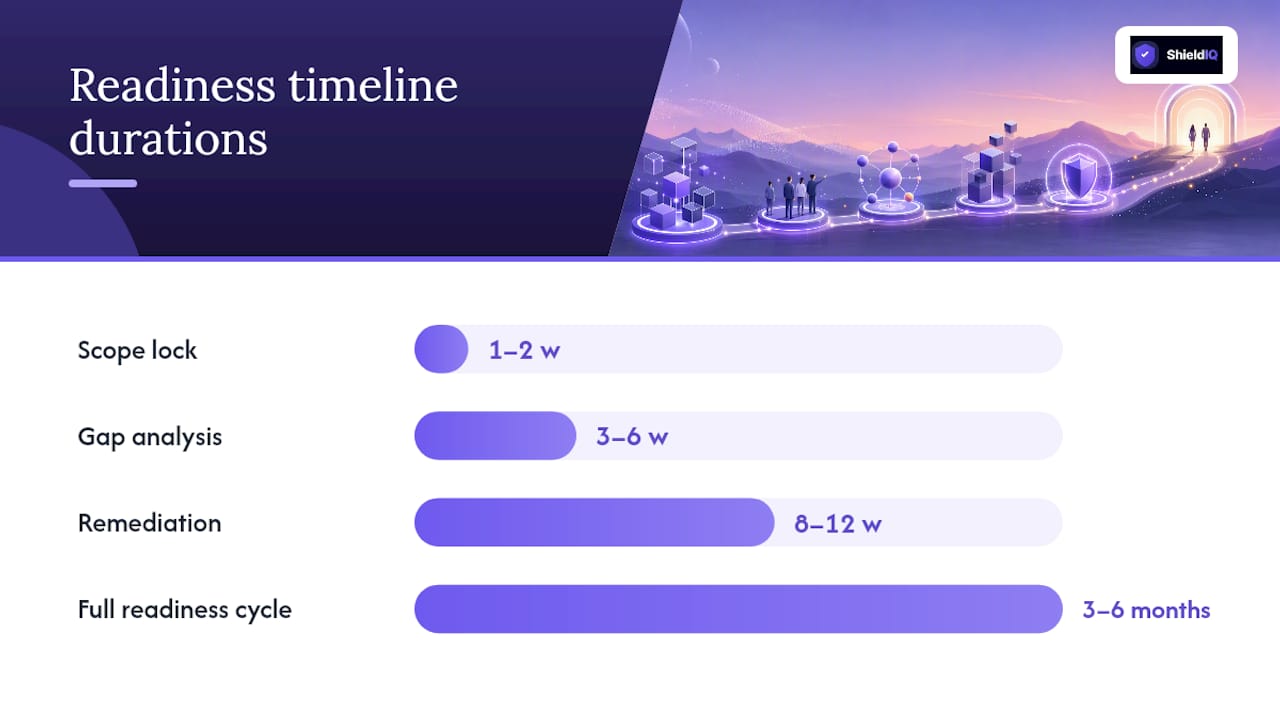
Readiness timelines vary by starting maturity, but the shape is consistent across most SMEs. Budget 3 to 6 months for the full readiness cycle, run 3 to 6 months before your intended observation period start, a window backed by readiness framework timing guidance.
Within that window, expect roughly:
- Weeks 1 to 2: scope lock and control matrix build
- Weeks 3 to 6: gap analysis and initial evidence testing
- Weeks 6 to 14: remediation, typically 8 to 12 weeks for common gaps like access reviews or change management
- Around day 90 before observation close: mock audit
Type I and Type II audits sit differently on this timeline. A Type I report assesses whether controls are designed correctly at a single point in time, so readiness for Type I can move faster since there's no evidence trail to build across months. A Type II report assesses whether those controls operated effectively over an observation period, usually 3, 6, or 12 months, which means your evidence collection has to run continuously for that entire window before the audit even starts.
Most SMEs pursuing SOC 2 for the first time choose Type I to get a report in market quickly, then move to Type II once evidence automation is mature enough to sustain a longer observation period without manual gaps. If your customers or procurement teams specifically require Type II, plan the longer observation window into your go-live date from day one rather than discovering the requirement mid-process.
Typical costs and resource expectations for readiness
Readiness costs break into three buckets: internal time, external consulting or auditor fees, and tooling.
Internal time is usually the largest hidden cost. A compliance lead or IT manager running a self-led readiness assessment alongside their normal role should expect meaningful time investment across the 3 to 6 month window, concentrated in the scoping and evidence-testing phases. Underestimating this is the most common budgeting mistake first-time SOC 2 organisations make.
External costs vary depending on which tier of auditor involvement you choose. A purely self-led review has no direct auditor cost beyond the eventual formal audit itself. Auditor-aligned readiness adds consulting fees for design-point reviews. Auditor-performed readiness, including a full mock audit, carries the highest upfront cost but the lowest risk of a failed or delayed observation period.
Tooling costs sit lowest but deliver disproportionate value. Manual evidence collection scales badly. Every additional control without automation adds recurring monthly work to pull and format evidence, work that compounds across a 3, 6, or 12 month observation period for Type II. Platforms that automate evidence collection and control mapping reduce this recurring cost substantially, which is why automation-first readiness strategies tend to pay for themselves before the audit even begins.
Whichever route you choose, build the cost estimate around the full cycle, not just the audit fee. Readiness, remediation, and the mock audit typically cost more in aggregate than the formal audit engagement itself.
Criteria for deciding when you are truly ready for a formal audit
Three checks, drawn from practitioner guidance, tell you whether you're actually ready rather than just hopeful.
First, confirm the right controls exist for every Trust Services Criterion in scope. Not planned controls. Live ones, operating today. Aprio's readiness checklist treats this as the first non-negotiable gate.
Second, confirm evidence is both available and sufficient. Availability means the artefact exists somewhere. Sufficiency means it's dated, attributable to a named owner, and covers the full period an auditor will sample, not just the most recent instance.
Third, confirm that evidence is what the auditor will actually rely on. This is the step teams skip most often. A log file that satisfies your internal reviewer might not satisfy an external auditor's sampling standard. Running a Test of One against each control, pulling the exact artefact an auditor would request, is the only reliable way to check this before the real audit begins.
If your gap register still has open items marked "high priority" with no assigned owner, you are not ready, regardless of how close your deadline is. If your mock audit surfaced fewer than a handful of findings and every one has a closed remediation date, you're in strong shape to schedule the formal engagement. Readiness isn't a percentage score. It's a binary confirmation across these three checks, repeated for every control in scope.
Examples of a completed gap register and sample templates
A working gap register needs five fields at minimum: control ID, finding description, owner, priority, and remediation deadline. A well-structured register (drawing on gap analysis template guidance) might record entries such as:
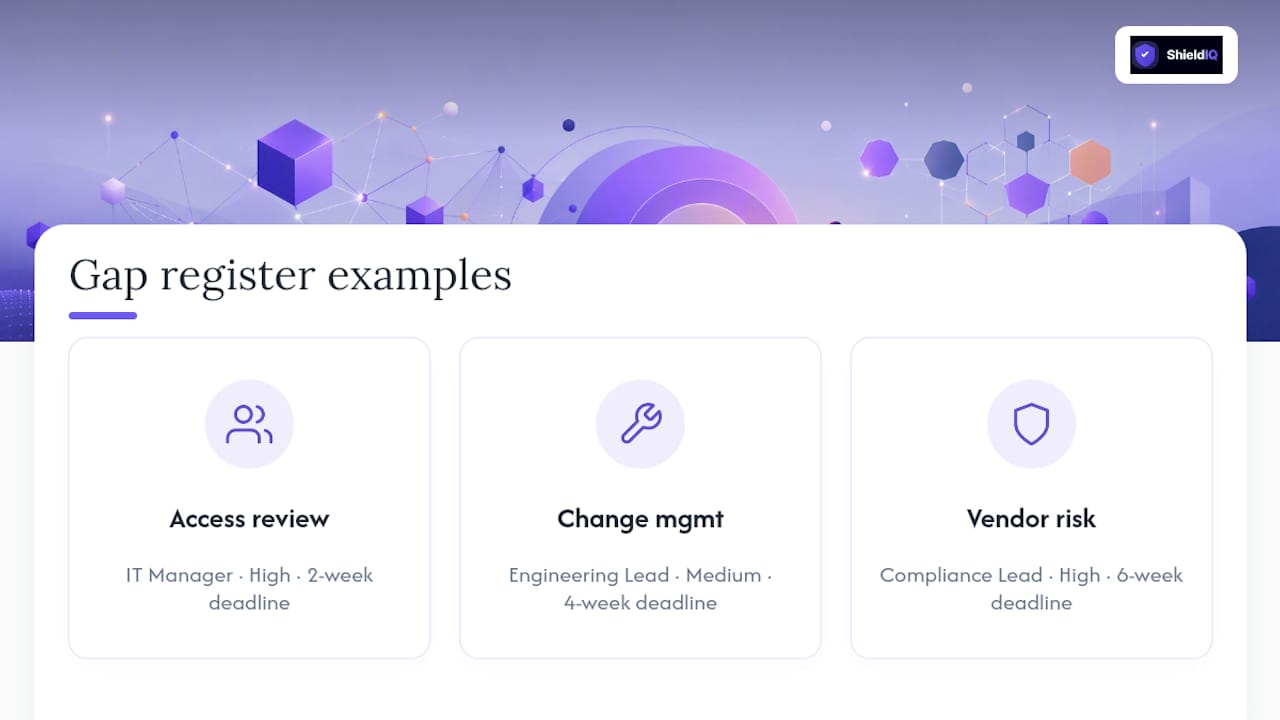
A finding against the access review control might read: "Quarterly access reviews are performed but not consistently dated or signed off by the reviewer." Owner: IT Manager. Priority: High, because this is a control auditors sample heavily. Remediation: implement a signed review template with a due date two weeks out.
A finding against change management might read: "Production deployments lack a documented approval step for three of twelve sampled changes." Owner: Engineering Lead. Priority: Medium, since most changes did have approval. Remediation: enforce a mandatory approval field in the deployment pipeline, four weeks out.
A finding against vendor risk might read: "No formal risk assessment exists for two critical subprocessors handling customer data." Owner: Compliance Lead. Priority: High, because vendor oversight gaps are a common audit exception trigger. Remediation: complete vendor risk questionnaires and file signed agreements, six weeks out.
Notice the pattern: every entry names a specific, provable gap rather than a vague concern, assigns one accountable owner, and sets a realistic deadline tied to effort. A register full of vague entries like "improve documentation" with no owner or date isn't a gap register. It's a wish list, and auditors, and your own remediation team, will treat it accordingly.
Getting internal buy-in during a readiness assessment
Readiness fails more often from poor internal communication than from technical gaps. Engineering teams asked to produce evidence at short notice, with no context on why, tend to deprioritise the request, and that delay cascades through your entire remediation timeline.
Set expectations early with a short kickoff that names the scope, the timeline, and exactly which teams will be asked for evidence and when. Engineering, HR, and IT operations are usually the three teams most affected, since they own access controls, onboarding and offboarding evidence, and change management logs respectively.
Assign a single internal owner, usually the compliance lead or a designated project sponsor, to track the gap register and chase remediation deadlines. Without one accountable person, gap register items drift indefinitely, each team assuming someone else is handling it.
Weekly or biweekly check-ins during the remediation phase keep momentum without becoming another meeting nobody wants. Share the live gap register status rather than a narrative summary. Teams respond better to a visible list of open items with their name against a deadline than to a general status update. If leadership needs visibility, a monthly summary showing gaps closed against gaps remaining is usually enough to maintain sponsorship without micromanaging the working team.
Choosing and working with an audit firm after readiness
Once your gap register is mostly closed and your mock audit findings are manageable, selecting the right audit firm matters almost as much as the readiness work itself.
Look for a firm with direct experience auditing organisations of your size and sector. A firm used to auditing enterprise financial services may apply a stricter sampling standard than your SME context needs, while a firm with no relevant sector experience may miss context that genuinely matters, such as how a smaller engineering team distributes control ownership.
Ask prospective firms how they handle evidence review before the formal observation period starts. Firms willing to review your control matrix and flag concerns during readiness, rather than waiting until fieldwork, reduce your risk of a late-stage exception significantly. This is also where Aprio's guidance on avoiding a strict DIY versus auditor split proves most useful: early auditor input at design points prevents you from building evidence trails the auditor later rejects.
Confirm scope and pricing in writing before the observation period begins, including how additional sampling or scope changes mid-audit would be billed. Ask for a realistic fieldwork timeline given your Type I or Type II choice, and check references from organisations of comparable size. A firm's report is only as valuable as your customers' trust in it, so reputation and clarity of communication matter as much as price.
Author perspective from a SOC audit practitioner
Most readiness assessments don't fail on complexity. They fail because a control has no named owner, so nobody notices it's slipped until the auditor asks. If you take one habit from this article, lock scope in week one and never let a control matrix row go unowned. Then build the matrix, run a real mock audit, and trust the register over your instincts.
— Matthew Lemon
ShieldIQCyber: how we help and how to get a demo
Readiness work stalls when it lives in spreadsheets nobody updates. ShieldIQ replaces that with a control matrix that populates itself: automated assessments generate scoring and gap analysis directly, AI-drafted policies fill evidence gaps without a blank page, and centralised documentation stays audit-ready instead of scattered across drives and inboxes.
Every checklist item covered here, control mapping, evidence collection, remediation tracking, maps to a module on the platform, so your gap register updates in real time rather than at the next status meeting. If you're weighing auditor-aligned or auditor-performed readiness, ShieldIQ's consulting services pair the platform with hands-on guidance from people who've run these engagements before.
Start with the SOC 2 compliance page to see how the automation maps to your current scope, then book a readiness scoping call to get a gap analysis running this week rather than next quarter.
Sources
- How to Run a SOC 2 Readiness Assessment: A 7-Step Framework (2026)
- SOC 2 readiness assessment (Aprio)
- What to Expect from a SOC 2 Readiness Assessment (Schellman)